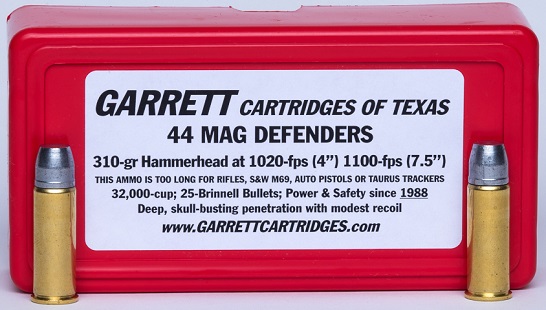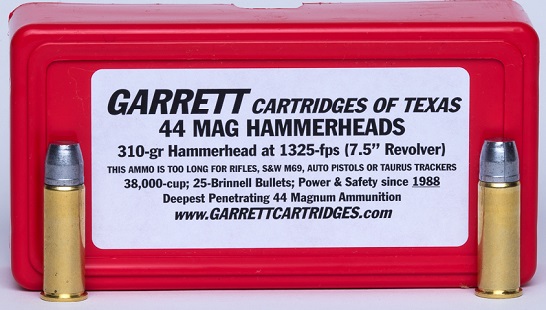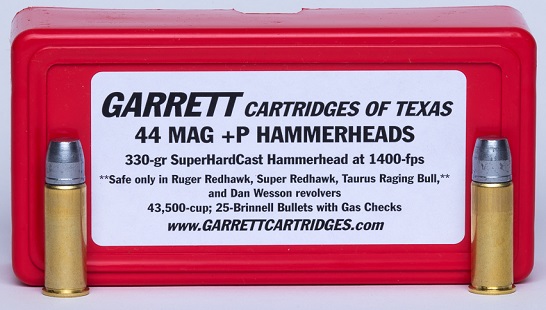
Garrett 44 Magnum Ammo
Central to
our efforts in 44 Magnum is the generation of the most power possible
per unit of chamber pressure. Unfortunately, conventional 44 Magnum
bullets provide substantial barriers to the production of maximum
power within safe pressure limits. Standard overall cartridge length
for the 44 Magnum, as defined by SAAMI, is 1.60-inches. This allows
the use of such cartridges in a variety of firearms such as lever-action
rifles and clip-fed autos, as well as revolvers. However, adhering
to this overall length substantially reduces the amount of power that
can be safely generated from revolvers. Revolvers, by virtue of their
long chamber throats, allow the use of longer cartridges than can
be used in other firearm types. In response to this, we have designed
our bullets to move weight forward, thus utilizing the long chamber
throats of the revolver as storage areas, as opposed to their normal
function as empty pre-barrel pathways. This is the defining characteristic
of our long weight-forward Hammerheads, which exhibit long noses and
unusually short bullet bases, resulting in increased gunpowder capacity
in the cartridge case. By so doing, we are able to generate more power
than can be safely generated by using conventional bullets, with their
characteristic short noses and long bases. An inspection of the loaded
revolver clearly demonstrates our weight-forward approach, as our
long bullet noses dramatically fill the chamber throats. This is the
first element of superiority of our Hammerhead bullets.

Cartridges
Left to Right: WINCHESTER 250gr, FEDERAL CAST-CORE 300gr, GARRETT
310gr, GARRETT 330gr |
Since wound channel diameter is much more a product of meplat diameter
than actual bullet diameter, it is our view that all non-expanding
hunting bullets should utilize very broad meplats. Broader meplats
result in larger diameter wound channels, which increase the speed
of incapacitation. Another benefit of broad meplated bullets is increased
penetration depth. This relationship of penetration depth to meplat
diameter is quite interesting, and fundamental to proper full-potential
bullet design. It is commonly believed that bullets with less meplat
diameter, such as truncated cones, offer less resistance to penetration
and, therefore, provide deeper penetration. This would be true if
terminal stability was not influenced by meplat diameter. However,
bullets such as truncated cones with less frontal area, and greater
front to back weight disparity, are far less stable upon impact, and,
as a consequence, provide less penetration. It is always easier to
observe than explain, but clearly as the weight disparity between
the front of the bullet and the rear of the bullet increases, there
is a tendency for the heavier end to overtake the lighter end upon
impact. This takes the form of the rear of the bullet moving forward
faster than the front, resulting in yaw which greatly inhibits penetration.
Simply stated, the bullet goes sideways. However, when the weight
disparity between the front of the bullet and the rear of the bullet
is minor, or non-existent, this tendency to yaw is greatly reduced
and the bullet penetrates deeper. However, once the issue of front
to back weight disparity is corrected, and bullet yaw is substantially
eliminated, further increases in meplat diameter result in reduced
penetration depth. These facts have led to our choice of .320-inch
diameter meplats for our 44 Magnum Hammerheads. Significantly less
meplat diameter results in reduced penetration, as does significantly
increased meplat diameters.
The third significant characteristic of our 44 Magnum ammo is our
special alloy and casting techniques. We designate our bullets as
SuperHardCast to differentiate them from common hard cast bullets,
as our bullets offer both greater strength, and greater freedom from
fracture than common machine-cast commercial bullets. Bullet hardness
is an important factor in bullet strength, but if not properly managed
can cause bullets to fracture when their inherent strength is exceeded.
Common to machine cast commercial cast bullets is the use of high
antimony alloy. This is used as it provides an acceptable rejection
rate, as utilized in automatic casting machines. Unfortunately, however,
high antimony alloys tend to fracture when stressed beyond their inherent
strength, as in point blank impact into the toughest game. I find
this to be unacceptable for bullets that might be used against heavy
or dangerous game. Consequently, our alloy is very low in antimony,
about 2.5% as opposed to the common 6-12% of popular commercial alloys.
Our alloy yields a bullet that is very hard, but will deform modestly
when stressed beyond its inherent strength. Commonly, our 44 Magnum
Hammerheads will shoot through broadside elk, even when the shoulders
are engaged, or penetrate to the hips on frontally shot grizzly. They
will also shoot lengthwise through heavy deer and boar, allowing bad-angle
shots, as when the game is going away from the shooter.
Our SuperHardCast 44 Magnum Hammerheads are the result of an unusually
comprehensive approach to ammo building. By designing our own super
efficient weight-forward bullets, we are able to achieve more power
per unit of chamber pressure than can be achieved using conventional
designs. Our weight-forward Hammerheads are also target-accurate,
delivering 1-inch groups at 50-yards from accurate revolvers. Also,
our .320-inch meplats offer the best in wound channel diameter, penetration,
and quick anchoring of game. Finally, our special alloy, bullet hardening,
and careful hand-casting provides completely reliable performance
against the heaviest game, where bullet impact stresses are the greatest.
Our 44 Magnum Hammerhead Ammo is simply without peer in the realm
of big game 44 Magnum hunting loads.